Cold Email Templates for Professors, Internships & Mentorship
Copy cold email templates for professors, research internships, and mentorship, with personalized one-liners, follow-ups, and real NIH and PhD outreach examples.
Published April 12, 2026
Use these cold email templates to contact professors, research staff, recruiters, or potential mentors. Start with one clear request, connect it to their work, and include only the experience that supports your ask. The examples below include emails I sent during my own research outreach.
Cold email template (copy and customize)
Subject: <SUBJECT>

Hi <NAME>,

My name is <YOUR NAME>, and I'm reaching out to ask <YOUR REQUEST IN ONE SENTENCE>.

I was especially interested in <their paper/project> — <1 sentence showing you read it + why it connects to your interests>.

A bit about me: <1 sentence: who you are + current status>. I've worked on <1 sentence: 1–2 relevant projects/internships>, and I'm interested in <1 sentence: interest area>.

If you're open to it, would you have 15–20 minutes for a quick chat next week? I'm available <2–3 windows or a general range>.

I've attached my resume/CV for context.

Thank you,
<YOUR NAME>
Cold email to a professor for a research opportunity
Use this when asking about a specific lab. Check the lab's recruitment page and the program's application instructions first; an email does not replace a required application.
Subject: Prospective PhD student — <research area>, <entry year>

Dear Professor <LAST NAME>,

I'm <NAME>, a <current role> at <INSTITUTION>. Are you considering new PhD students for <ENTRY YEAR>?

I read your paper on <TOPIC>, and I was particularly interested in <SPECIFIC METHOD OR FINDING>. My work on <YOUR PROJECT> involved <RELEVANT SKILL>, and I'd like to explore <RELATED RESEARCH QUESTION>.

I've attached my CV. If my interests fit your lab, could you let me know which program or application route I should use?

Thank you,
<NAME>
Looking for labs to contact? Browse the PhD opportunities directory, then use my PhD application toolkit to organize your preparation.
Cold email template for an internship
Subject: <TERM> internship inquiry — <TEAM OR RESEARCH AREA>

Hi <NAME>,

I'm a <YEAR / DEGREE> student at <SCHOOL> interested in internship opportunities with <TEAM> during <DATES>.

Your project on <SPECIFIC TOPIC> connects to my experience building <RELEVANT PROJECT>. I used <SKILL OR TOOL> to <WHAT YOU ACTUALLY DID>.

Is your team recruiting interns for that period, and is there a preferred application process? I've attached my resume and included <RELEVANT PROJECT LINK>.

Thank you,
<NAME>
For the story behind my own application process, read how I landed a NASA internship. Follow the employer's official application process alongside any outreach.
Cold email template for mentorship
Ask for advice on one decision before asking someone to commit to an ongoing mentoring relationship.
Subject: Advice on moving from <CURRENT FIELD> into <TARGET FIELD>

Hi <NAME>,

I'm <NAME>, currently <BRIEF BACKGROUND>. I found your <TALK / ARTICLE / PROJECT> while learning about <FIELD>.

Your experience with <SPECIFIC TRANSITION OR PROJECT> is relevant to a decision I'm making: <YOUR QUESTION>.

Would you be open to answering that question by email, or to a brief conversation if easier? I appreciate your time.

Thank you,
<NAME>
Quick rules
- Subject line: Use a direct subject that sets context immediately (examples below).
- Ask first: Put your request in the first 1–2 sentences.
- Sell yourself (briefly): 1–2 lines on relevant experience + what you're trying to do next.
- Show you did homework: Reference 1 paper/project/post/talk (1 sentence).
- Make it easy to say yes: Suggest a short call time window, or ask a simple yes/no question.
- Attach your resume/CV: Mention it in the final line.
The human part (mindset)
- You're not "asking for a favor". You're starting a conversation. Make it easy for someone to respond, even if the answer is no.
- Respect attention: Most people skim. Write so the first 2 lines answer: Who are you? Why them? What do you want?
- Aim for warmth + clarity: professional doesn't mean robotic.
Before you email (5–10 minute prep)
1. Pick the right person
- Academia: PI, a senior PhD student/postdoc, lab manager, program coordinator (depending on the ask).
- Industry: hiring manager, team member in the role, recruiter, alumni from your school.
2. Do a 3-point scan (enough to personalize without over-investing)
- 1 specific thing they worked on (paper/project/blog/talk)
- 1 theme you genuinely care about
- 1 reason you are a plausible fit (coursework, project, internship, skills)
3. Decide your single ask
Examples: "Are you taking students?", "Could you point me to a paper to start with?", "Would you be open to a 15-minute chat?", "Is there a process to apply to your team?"
Pick your ask (use one)
- Quick chat: "Would you be open to a 15–20 minute chat about <topic>?"
- Openings: "Are you currently taking students / hiring interns for <term/team>?"
- Direction: "If you're not the right person to ask, who would you recommend I contact?"
- Materials: "If it's helpful, I can send a short blurb / CV tailored to <topic>."
Effective cold email one-liners
Choose one specific opening and replace every placeholder. These are adaptable examples, not claims about work you have done.
- Professor: "I read your <paper/post> on <topic> and was curious about <one detail>."
- Research internship: "Your point about <specific result/method> stood out. I'm working on something similar in <your context>."
- Career transition: "I'm coming from <your angle>, and your work on <topic> feels like a great fit because <specific overlap>."
- Mentorship: "Would you recommend a good starting point to understand <subtopic> in your work?"
What to attach / include
- Resume/CV: yes.
- Portfolio/GitHub: only if it supports your ask.
- Writing sample / manuscript: only when relevant (and mentioned in the email).
- Keep it minimal. Too many attachments can reduce replies.
When you don't get a reply (don't take it personally)
- Non-response usually means inbox overload, not rejection.
- Follow-ups are normal. Keep them short and polite.
- If there's still no response after 2 follow-ups, move on (and consider trying a different contact in the same org).
Subject line options
Academia
- Prospective PhD Student — interested in <area>
- Prospective Master's Student — <program/area>
- Question about your work on <paper/topic>
- Interested in potential rotation / RA opportunity in <term>
Industry
- Interested in <team/domain> — <your role goal>
- Quick question about <company/team> work on <topic>
What to customize (checklist)
- Request sentence: clear and specific (meeting? advice? open positions? rotation? collaboration?)
- Credibility line: 1–2 strongest experiences only
- Alignment line: mention 1 concrete thing from their work
- Call to action: propose times OR ask a yes/no question
- Attachments/links: resume/CV, portfolio, GitHub, paper/preprint (only if relevant)
Follow-up schedule
- Follow up #1: 4–7 days later (short, 2–3 sentences)
- Follow up #2: 7–10 days after that (one last polite ping)
Follow-up template
Subject: Re: <SAME SUBJECT>

Hi <NAME>,

Just following up on the note below in case it got buried. I'd still love to ask <your request>.

Thanks again,
<YOUR NAME>
Examples
Example 1 (Academia)
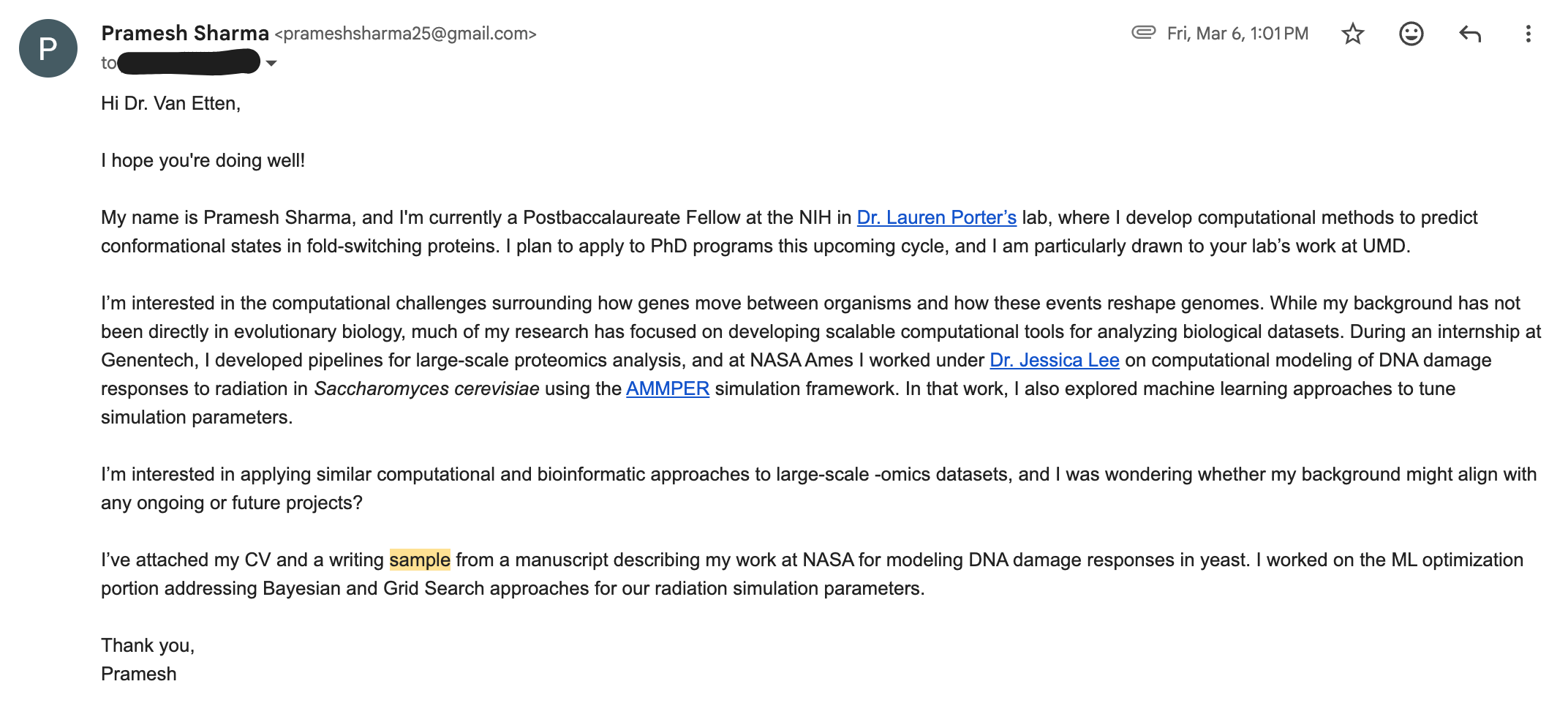
Goal: Ask if your background aligns with ongoing/future projects; signal you're applying this cycle; include CV + writing sample.
Excerpt from my original email:
I’m interested in applying similar computational and bioinformatic approaches to large-scale -omics datasets, and I was wondering whether my background might align with any ongoing or future projects?
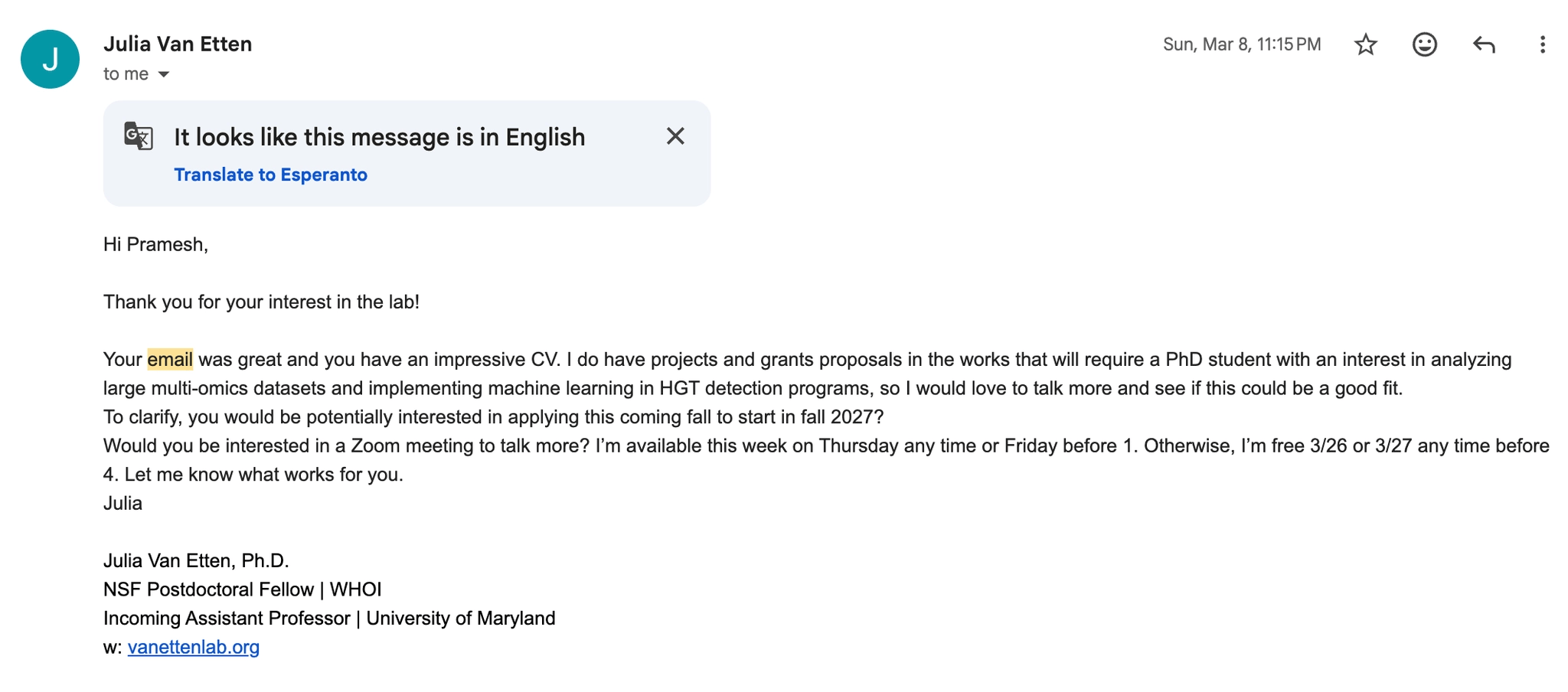
This request connects my computational background to the lab's work and asks about fit. The screenshot includes the longer background and supporting materials; this excerpt omits contact details.
What worked:
- Opened with a direct intro + why you're emailing now (applying this cycle).
- Clearly tied interests to the lab's research area.
- Credibility from multiple experiences (NIH postbac, internship(s), tooling/pipelines).
- Mentioned reading/knowing specific work (papers, framework).
- Closed with attachments + clear ask.
Result: I'm now in the process of writing a grant with a future prospective PI.
Example 2 (Academia/Industry)
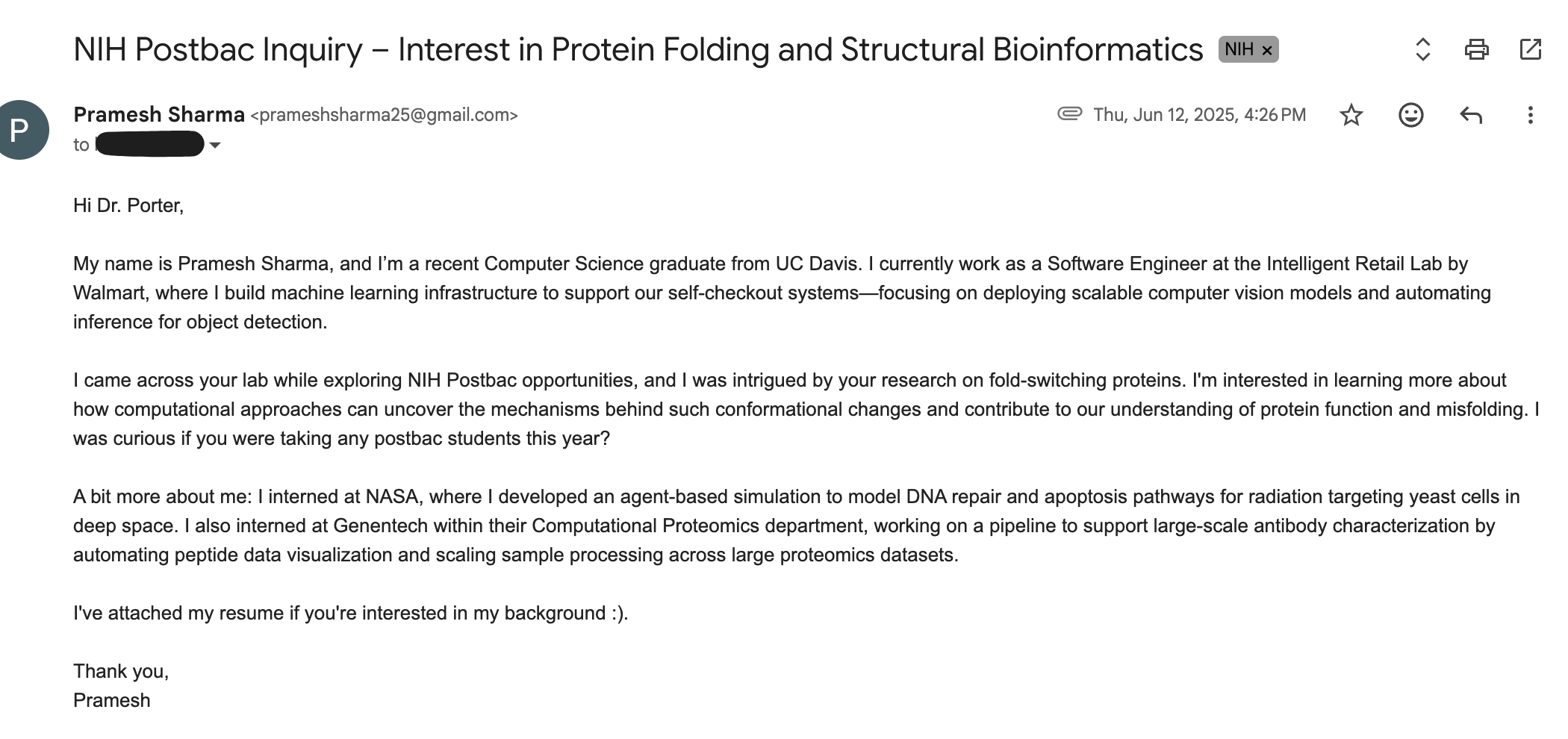
Goal: Ask if the lab is taking postbac students; brief and clearly aligned.
Excerpts from my original email:
I came across your lab while exploring NIH Postbac opportunities, and I was intrigued by your research on fold-switching proteins.
I was curious if you were taking any postbac students this year?
These two lines name a specific research interest and ask a question the recipient can answer directly. Contact details are omitted from the excerpts.
What worked:
- Very clear ask ("are you taking postbac students this year?").
- Short background paragraph focused on relevant skills.
- Mentioned attached resume.
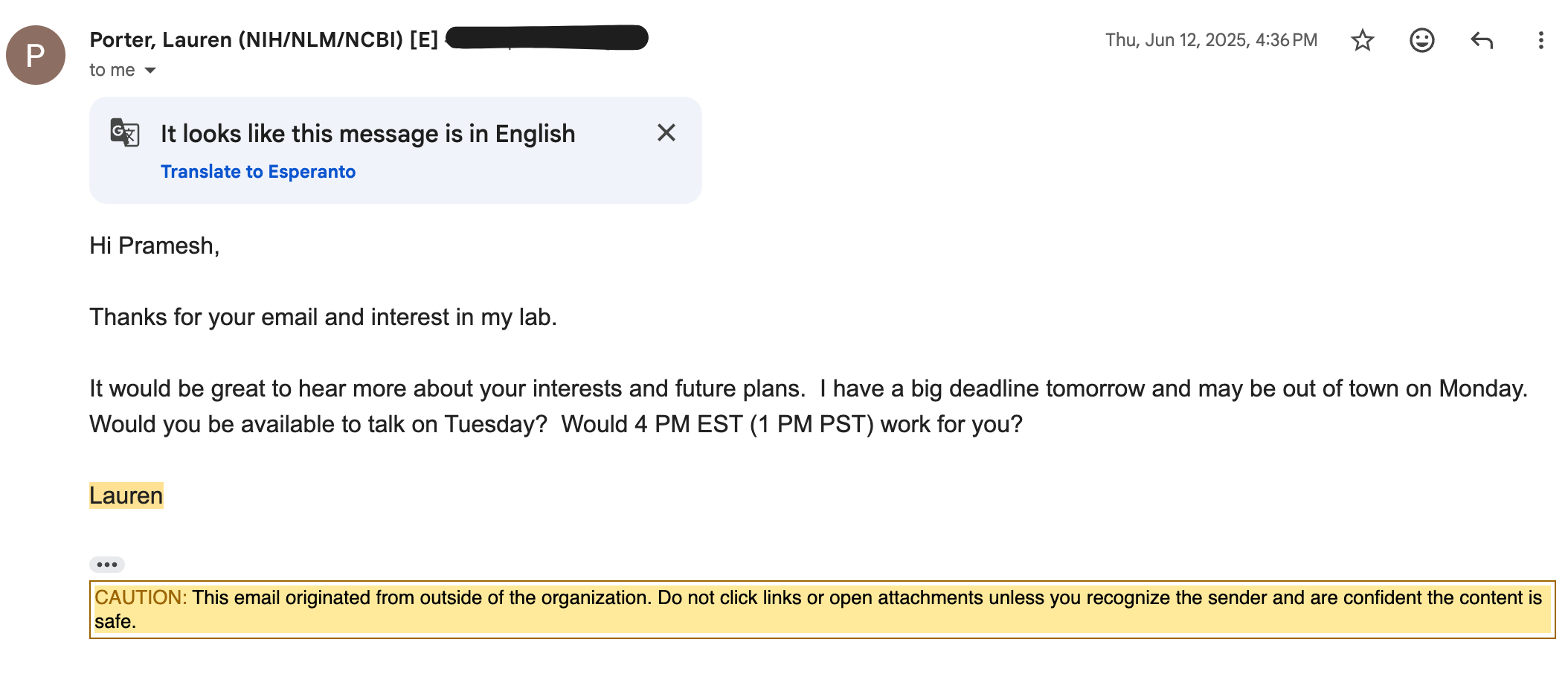
Result: I ended up interviewing for a postbac position and joined the lab in August 2025.