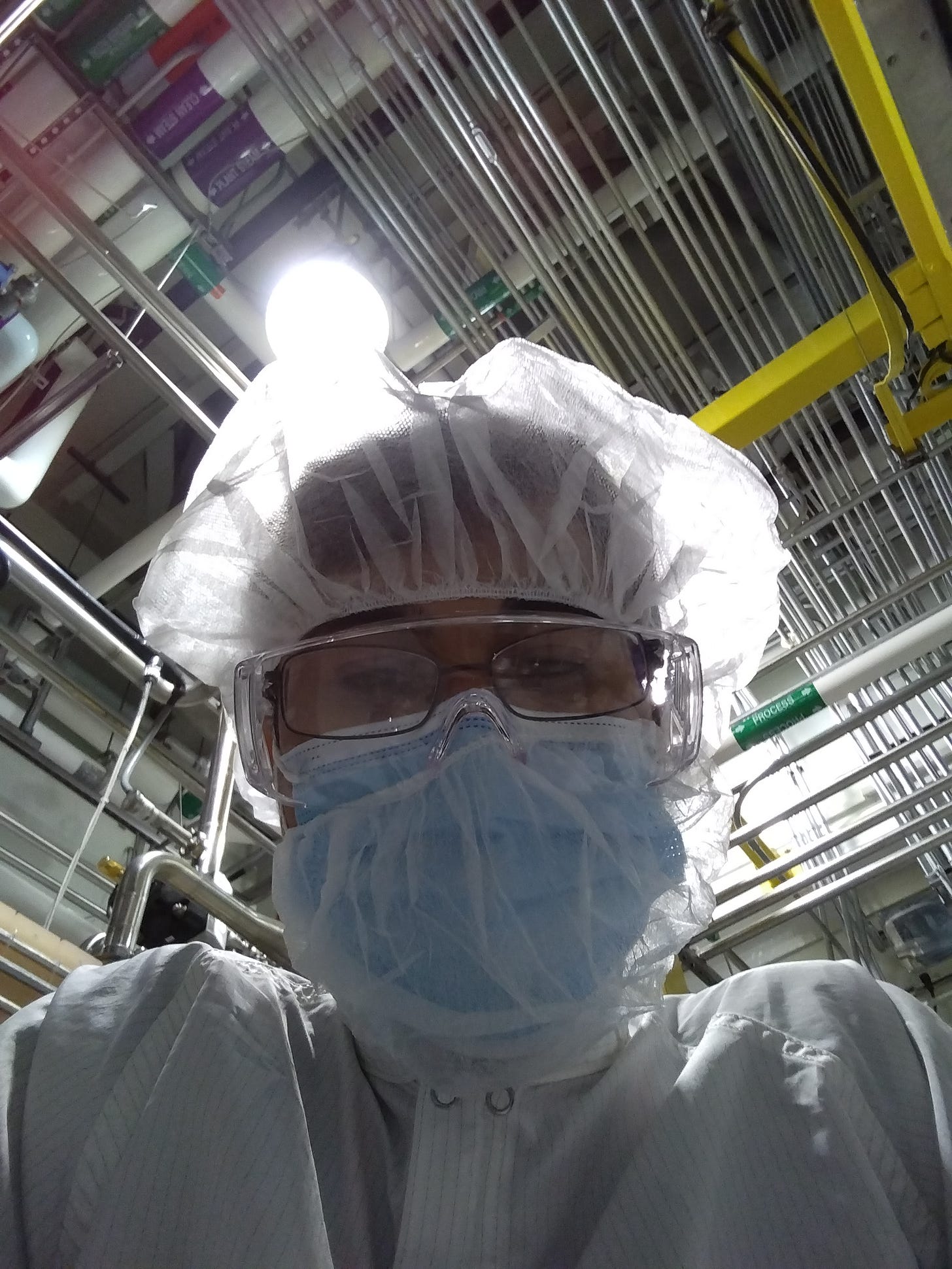
There's a room you have to pass through before you can enter the manufacturing floor at Genentech. It's called a gowning room, and it does exactly what it sounds like. You put on a jumpsuit. Then a hair net. Then a mask. Then goggles over the mask. Then another layer if the room requires it. By the time you're done, you barely recognize yourself.
I remember standing there the first time, looking at my reflection in the small mirror on the wall, thinking: this is what it looks like to take medicine seriously.
Genentech was founded in 1976 in South San Francisco — the oldest biotech company in the world. By the time I arrived as an intern, it had become part of Roche, one of the largest pharmaceutical companies on earth. But walking those corridors, you didn't feel like you were inside a corporate giant. You felt like you were inside something alive.
Long narrow pipes ran overhead connecting heat sinks, water lines, and biochemical feeds. Bioreactors the size of small rooms churned continuously. The hum of machinery was constant. It reminded me of the Fairy Godmother's potion factory in Shrek: bubbling vials, assembly lines, an overwhelming sense that something intricate and almost magical was being produced at a scale that shouldn't be possible. Except here, the magic was biochemistry. And the potions were real.
Every room I passed held its own mystery. Behind one door, biochemists were coaxing proteins into folding correctly. Behind another, chemical engineers were optimizing yield. They were speaking different languages, one rooted in biology, one in thermodynamics, and somehow producing the same sentence.
That was the thing that struck me most. Not the scale. Not the prestige. The collaboration.
My project that summer involved automating drug manufacturing campaigns and assigning process engineers to each one. On paper, it sounds like scheduling software. In practice, it meant I was the connective tissue between two worlds that don't always speak to each other: the scientists who design the process and the engineers who run it.
If a bioreactor went down at 3am, the right engineer needed to be paged immediately. Not the wrong one. Not nobody. The right one. Because somewhere downstream, a patient with a rare disease was waiting on a drug that couldn't be delayed by a miscommunication in a handoff system.
I built the system that made sure that didn't happen.
There's a kind of beauty I didn't expect to find — two disciplines, usually siloed in academia and industry alike, moving in lockstep toward something neither could produce alone.
I came into that internship thinking of myself as an engineer who happened to be interested in science. I left thinking of myself as something in between. Someone who had seen what's possible when the boundary dissolves.
The most important medicines in the world aren't discovered in a single eureka moment. They're manufactured, shift by shift, room by room, by people in layers of protective gear who never meet the patients they're keeping alive. There's something quietly profound about that. A kind of distributed heroism that doesn't photograph well but matters enormously.
I still don't have a clean answer for what I am — scientist or engineer. But I've stopped looking for one.