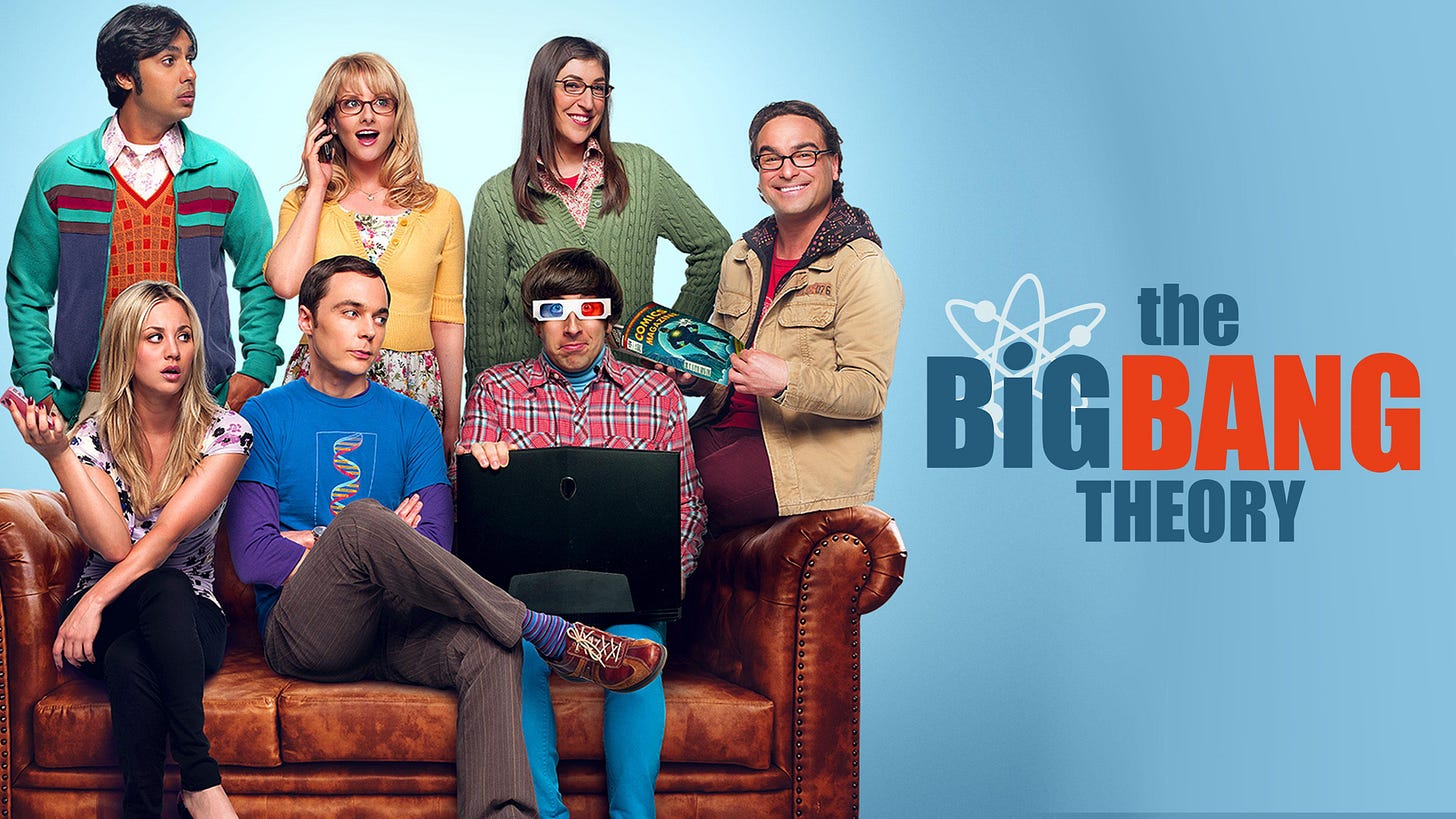
I grew up watching The Big Bang Theory every Saturday night as an eighth grader on an old television my great-grandparents had left behind. At the time, I thought it was hilarious that someone had taken a group of Caltech physicists, added a laugh track, and somehow turned academia into primetime entertainment.
Looking back, I don’t think I appreciated how unusual that was.
Before then, science had mostly existed in textbooks and classrooms. Scientists were names attached to discoveries or equations. The Big Bang Theory was probably the first time I saw researchers as actual people - people who had careers, argued with friends, got excited over obscure problems, and somehow built their entire identities around asking questions no one else was asking. For an eighth grader trying to imagine what adulthood looked like, that was exciting.
Of course, I had no idea what I actually wanted to do.
Every few months, I found myself wanting to become whichever character I thought was the coolest that week.
I wanted to be an experimental physicist like Leonard because lasers are objectively cool. Then I learned about distant galaxies, redshift, and the expanding universe, and suddenly I wanted to be an astrophysicist like Raj, minus his inability to talk to women. Howard appealed to the engineer in me: sarcastic, endlessly building things, and somehow managing to turn being a giant nerd into a personality. Sheldon was always the extreme case. While he’s probably the person I related to the least, I’ve become convinced there’s a little bit of Sheldon in every scientist. His certainty, his obsession with being right, and his complete lack of social awareness are exaggerated for comedy, but they also remind us that expertise doesn’t automatically come with maturity.
As an indecisive eighth grader, I bounced between all of them.
Funny enough, I ended up becoming a little bit of each. The need to solve problems and be a subject matter expert has taken over my life, and having gotten a taste of research, I love the possibility of combining disciplines to tackle problems most people never get to touch.
But the show doesn't just glorify academia. It occasionally stumbles into its real problems too. In "The Benefactor Factor," the guys are pushed to pitch their research to wealthy donors, chasing funding instead of just doing the work. I'd never sell my soul to the billionaire class to keep a lab running, but the episode gets at something real: researchers increasingly have to sell their work, not just do it. That's stopped being a hypothetical for me. At the NIH, I've watched funding cuts reshape what gets studied and by whom, as the current administration has pulled back federal support for research institutions.
Despite all of academia’s flaws, I’ve decided to pursue a PhD.
Not because I think it’s an easy life or even the most financially rewarding one. And certainly not because sitcoms accurately portray what graduate school is like. I’m pursuing it because I still believe the work matters. Scientific progress has always depended on people who were willing to spend years answering questions that seemed unimportant until they suddenly weren’t.
Maybe I won’t make a discovery that changes the world. But if I can contribute one useful idea, mentor someone who goes on to do incredible work, or help move a field forward even a tiny bit, that’ll be enough.
Sheldon would probably say the odds aren’t good. I’m betting on them anyway.