I started reading science fiction during the pandemic as an escape. Not from boredom, but from the particular claustrophobia of being trapped inside your own life, watching the world outside your window freeze while everything inside your head kept moving. The books I found pulled me in different directions: space-hopping across galaxies, living the nomadic life of a freelance hacker, navigating societies that had quietly collapsed under the weight of their own systems. Science fiction gave me permission to imagine a different kind of world. It opened me up to how fast technology moves and, as a consequence, what happens to the people who don't move with it.
Snow Crash was one of those books.
What drew me in wasn’t the plot. It was the choice. Neal Stephenson built a world where you could decide who you were going to be: a loyal cog inside a corporate enclave, defending the billionaires who had quietly purchased society - or a nomad, completely outside that system, living as the antithesis of control. I was enthralled by that. The idea that even inside a crumbling world, agency was still possible. That the hacker spirit: scrappy, decentralized, ungovernable, could survive anything the oligarchs threw at it.
I read it as a fantasy. I’m not sure I can anymore.
The world Stephenson imagined in 1992 wasn’t supposed to be a blueprint. But somewhere between then and now, someone seemed to be taking notes.
Take the Asherah virus: a pathogen that doesn’t infect the body, it infects the mind. It spreads through language, through symbols, hijacking the brain’s deeper operating system before rational thought even has a chance to intervene. Stephenson framed it as science fiction. But scroll through any social media feed for twenty minutes and tell me the mechanism feels unfamiliar. The platforms aren’t delivering information anymore; they’re delivering stimulation, engineered to keep your attention locked in place. The virus doesn’t need a name when it has an algorithm. We handed over the keys voluntarily, and we called it connection.
Then there's L. Bob Rife. The novel's central villain, a man who controls the physical infrastructure of global information and uses that leverage to bend entire populations to his will. In 1992, he was a warning. Now he reads like a composite sketch. The names have changed. The dynamic hasn't. A handful of people own the pipes, and the rest of us flow through them.
What unsettles me most, though, is the franchise model. In Snow Crash, society doesn't collapse into chaos. It fragments into branded enclaves. Corporations become nations. Your identity is determined not by where you were born, but by which enclave you belong to. It seemed like a sharp satire of consumerism when Stephenson wrote it. Now I look at how people organize themselves around platforms, their feeds, their communities, their algorithmic tribes, and I'm not sure the satire landed. We let brands become the containers of our identity without noticing that the container was the whole point.
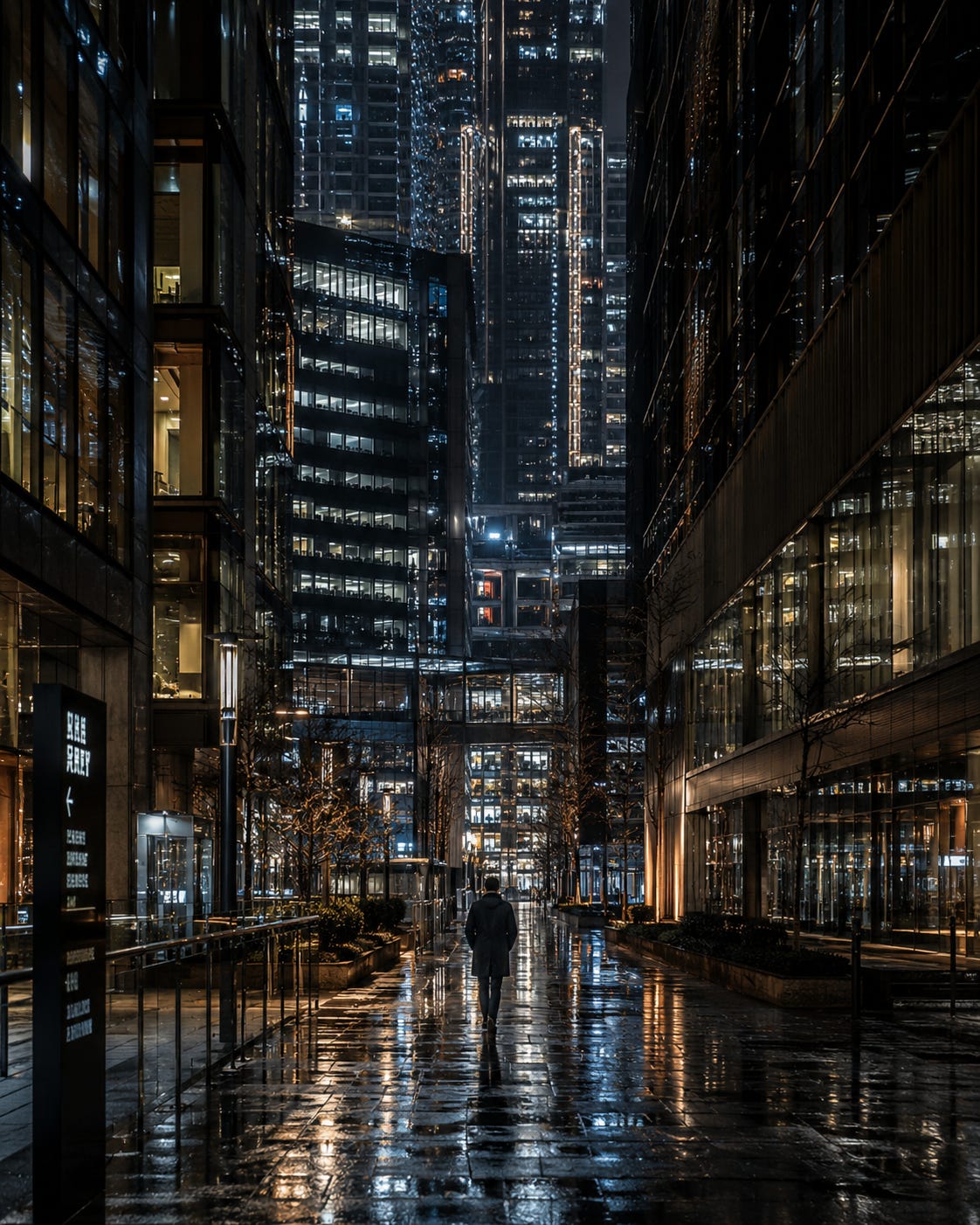
I was recently in New York and while most people seem energized by the city's momentum, I felt the opposite - overwhelmed by a sense of disconnection I couldn't quite place. The architecture doesn’t breathe the way it used to. Glass towers press against each other in tight corridors, optimized for density, for commerce, for the efficient movement of people between one economic function and the next. There’s less sky. Less green. The primitive instinct to exist among other living things, to be one species among many, gets quieter with every new development. The city used to feel like a place people built to live in. Increasingly it feels like infrastructure. A substrate. Something to run the economy on.
Snow Crash captured that too. The sprawling Burbclaves, the polluted corridors, the sense that the natural world had been quietly deprioritized in favor of something more legible, more monetizable. I used to read those descriptions as satire. Now I walk outside and I’m just reading.
Here's the thing about dystopian fiction: it's supposed to be exciting. The stakes are clear, the enemy is legible, and the hero, even when they lose, is at least moving. There's something clarifying about that kind of story. You know what you're fighting.
I’m not excited by the dystopia anymore.
Not because it’s gotten less interesting, but because it’s stopped being fiction. The distance that made Snow Crash thrilling to read was the distance of impossibility. It was a warning you could appreciate from the outside. But warnings have a shelf life. At some point the thing you were warned about arrives, and it doesn’t arrive dramatically. It arrives the way it always does: incrementally, plausibly, wrapped in something that seemed reasonable at the time.
What I keep coming back to is the protagonist - Hiro Protagonist - what a fitting name. In the book, he represented the last form of genuine freedom. Ungovernable, outside the system, beholden to no enclave. I wanted to be him when I read it. I still do. But I'm not sure the outside exists the same way anymore. The platforms got everywhere. The enclaves are digital now, and they're harder to leave because they don't have walls. Just algorithms that make leaving feel pointless.
It’s time I switch to a flip phone.